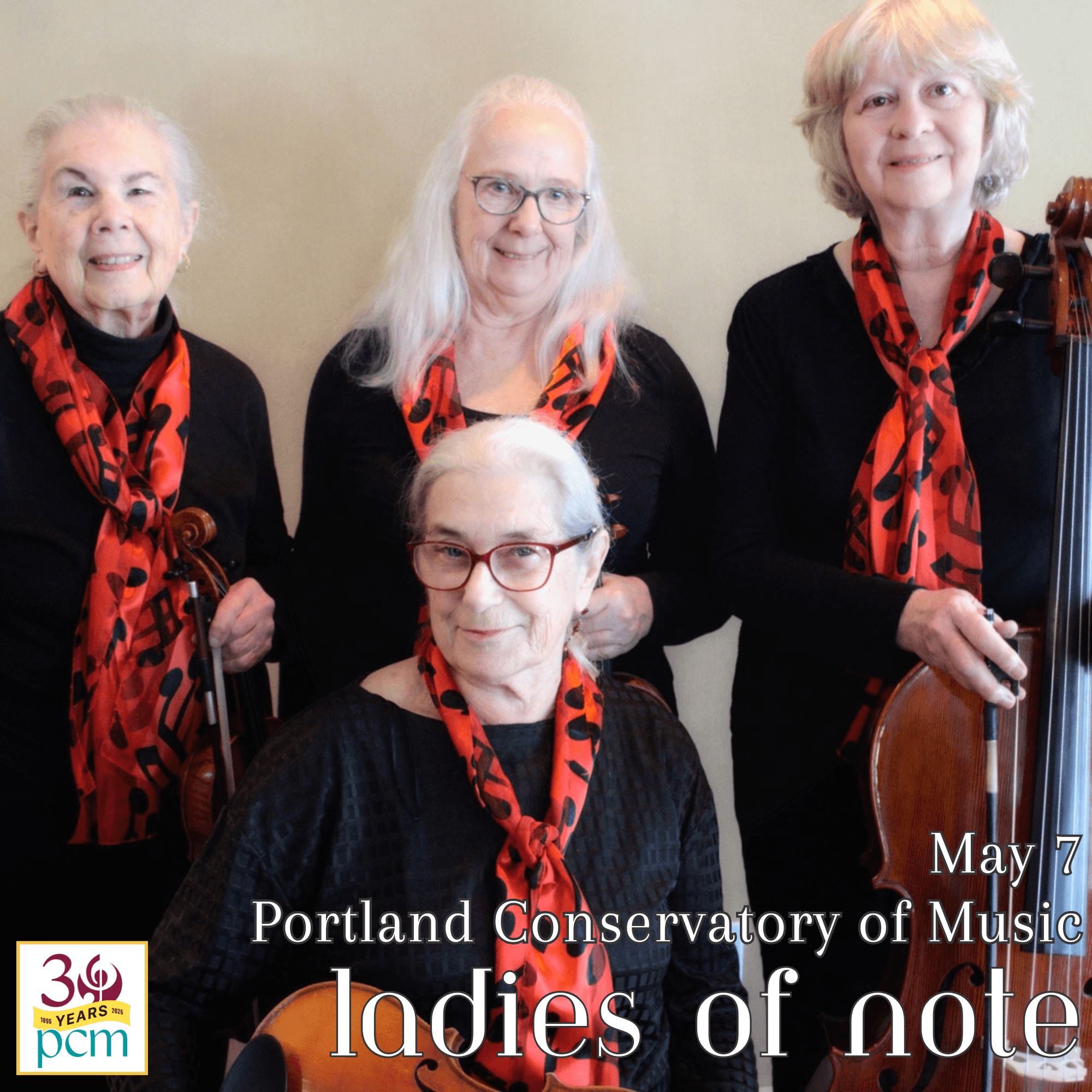
Program:
Franz Schubert (1797–1828)
Quintet for two violins, viola, and two cellos
Allegro ma non troppo
Eleanor Lehmann, Betsy Hooper, violins
Susanna Adams, viola
Kathrine Berry, cello
Guest — Ben Powers, cello
Alexander Borodin (1833–1887)
Quartet No. 2 in D Major
Allegro moderato
Nocturne
Scherzo
Eleanor Lehmann, first violin
Betsy Hooper, second violin
Susanna Adams, viola
Kathrine Berry, cello
“I’m a composer in search of oblivion; I’m always slightly ashamed to admit I compose.” So said one of the most brilliant Russian scientists of his generation, for whom composing was only a hobby. Welcome to the extraordinary world of genius melodist Alexander Borodin.
Picture it! It could have been a busy marketplace in ancient Baghdad filled with life and activities of the times. Then… we suddenly make a magical leap to the year 1955, where under André Previn’s direction, MGM’s Studio Orchestra performs unforgettable numbers such as “Strangers in Paradise,” “…And This Is My Beloved” and “Night of My Nights.”
Who wrote such captivating melodies? In answer to that question, let it be said that the composer was not of the 20th century, but of the 19th century. The composer of this enchanting music was none other than Alexander Borodin who had been dead for 70 years.
Borodin had an unconventional start in life. He was born in 1833, the illegitimate son of Prince Luka Spanovich Gedianov, an elderly nobleman who had enjoyed the intimate company of a beautiful and intelligent 24 year old by the name of Avdotya Konstantinova Antonova. The result was a baby boy, Alexander Porforyevich who, as was common practice to save public embarrassment, was registered under the name of one of the Prince’s serfs, Porfiry Borodin.
Alexander’s teenage years were divided fairly equally between musical and scientific pursuits. After enrolling at the Medic-Surgical Academy in 1850, Borodin devoted the following 10 years of his life to chemical research. But music was always hovering in the background. In 1861, while in St. Petersburg, he met and fell in love with Ekaterina Protopopova, a brilliant 29 year old piano virtuoso. Thus, with this turn of events, Borodin felt compelled to follow his desire to compose a piano quintet. Thus proclaiming his musical genius.
In 1862, he was introduced to one of the founding fathers of modern Russian music: Mily Balakirev. It was he who inspired the formation of the “Kutchka” or “Mighty Handful”—himself, Rimsky-Korsakov, Mussorgsky, Borodin and Cui who dubbed them “The Five.” Thanks to Balakirev’s visiting the Caucasus regions of Russia to study and notate the region’s folk music, he inspired Borodin’s desire for this musically exotic taste in folk music resulting in the First Symphony which would become the cornerstone of the fast-emerging Nationalist School.
Between Music and Science, Borodin was a devoted family man and although he and his wife were not blessed with children of their own, they lovingly adopted a couple of children. With such a happy life, Borodin found time to compose his “Second Quartet in D Major” during the course of a country summer retreat in the township of Zhitovo (south east of Moscow) and completed it in August of 1881. By Borodin’s own standards, the work was finished extremely quickly, taking approximately two months from conception to completion. He dedicated the work to his wife, Ekaterina.
After finishing his Second Symphony, word got out of Russia regarding his extraordinary talent. He wrote the beautiful symphonic picture music, “in The Steppes Of Central Asia,” which takes his unique Oriental musical style to extreme levels of poetic sensitivity. Also, for years he had been working hard on his opera “Prince Igor,” which includes the popular “Polovtsian Dances.” Sadly, he wouldn’t live to complete it.
Time was running out for Borodin. Having to care for his terminally ill wife, his energies were “ebbing away” and on February 27th 1887 he passed away. His wife passed shortly thereafter.
Franz Schubert: The Tragic Bohemian
Franz Schubert (1797-1828) was surrounded by scandalous, tragic, or “double-life” gossip in his respective circle. He was a prolific Austrian composer who bridged the Classical and Romantic eras, creating over 1000 works (lieder, symphonies and chamber music) all in a lifetime of 31 years.
Born on January 31,1797, in Himmelpfortgrund, a suburb of Vienna, he received early music training from his father and brother. At age 11, he became a singer at the Imperial Court Chapel and a student at the Imperial Seminary. He studied with Antonio Salieri, a prominent composer in Vienna at that time.
During the turbulent, conservative, repressive years around 1815 in Vienna, where Vienna was under strict surveillance by the government, it is reported that in 1820 Schubert along with his friends were arrested for associating with individuals suspected of radical political views.
Within his close-knit group of artistic friends, he was known as “Schwammerl”or little mushroom due to his short, stocky stature. He suffered from poor health for several years, likely aggravated by poor living conditions which led to the confusion as to whether his early death was caused by typhoid fever, or complications from syphilis and the toxic effects of mercury used as a treatment for that disease at the time. But even in such a short life span, he managed to pen over 600 songs, nine symphonies and many chamber music works. His work is characterized by lyrical melodies and rich harmonies that defined the emerging Romantic style. Lacking a wealthy patron, he was able to make a living through freelance composing, teaching, and publishing. His music was frequently performed in intimate, private settings known as “Schubertiades.”
Some musicologists at that time speculated that Schubert was either homosexual or bisexual because of his intense relationships with men. However, history shows that Schubert apparently did fall in love with one of his pupils, the Countess Caroline Esterhazy, but it was a one sided affair since according to the Countess, Schubert never expressed this feeling outwardly to her and chose instead to hide his feelings within the music he composed.
Two particularly interesting issues regarding the first movement of the String Quintet in C Major, reveals an unusual trend. The first according to David H. Miller, University of California, Berkeley is, “it was found that about a third of all performances omit the final measure of the exposition, when going on to the development. While there is no textual basis for this decision, some performers may have been motivated by a sense that measure 154 is really a first ending in disguise…..and seems to to point towards a repeat of the exposition and omitting the measure creates no obvious problem when continuing on to the development.
The second interesting issue is although other string quintets written by other composers of the time added an extra viola, only Schubert added an extra cello which added an emotional depth and richness to the sound.”
In essence, while contemporary reviews of a “first performance” are sparse, the lasting legacy and critical commentary highlight the Quintet’s groundbreaking sound, its intense emotional power, and its unique ability to convey deep, poignant beauty, often linked to its innovative cello texture and melodic genius.
About Ladies of Note:
“Ladies of Note” in music, encompasses historic and contemporary trailblazing women who have achieved significant, often barrier-breaking musical success. It also refers to some who were, or are, of the social elite. But let us not forget those women who dedicated so much to the advancement in the sciences, educational fields and politics of the times past and present. Regarding our use of this title, we use it solely to describe what we do and how well we can do it.
At present, we are not the only “all women group” using this title especially in the music field. There are two distinct choirs operating under this same name. There is a choir on the Bruce Peninsula in Ontario, Canada and another based in Hest Bank/Morecambe, UK. There are more groups made up entirely of women who use “Women” instead of “Ladies,” and sometimes there is the addition of the letter “s” to Note, which changes the ability to use the “double meaning” purpose of the singular form of the word.
Our group of “Ladies” is made up of professionals from other fields, who enjoy music in general and have the technical and musical ability to join an ensemble with others, playing their respective instruments purely for the pleasure of making music together. For us, performing for an audience is “frosting on the cake,” especially when everything goes well and the audience is pleased.
So in closing, we are ladies who perform music “note by note”—and as we play the music for you, please “note” the love we have for music in general.
About the Performers:
Eleanor Lehman began her musical studies at age 5 on violin at the San Francisco Conservatory of Music. She received a degree in music education and performance from San Francisco State University in 1963 and joined the teaching force in the public school system of San Francisco as a music teacher for the year prior to being offered the opportunity to move to Mexico, where she lived with her husband and children, working as a violin and viola teacher at the Conservatorio National de Mexico and performing in many of the professional orchestras of the region in and around Mexico City. In 1973, she spent a year living in Holland and was active in the musical community of Nijmegen as a violist. In 1986, she returned to California where she took music education classes at the University of the Pacific in Stockton and played viola with the San Rafael, Merced, Modesto and Stockton symphonies before entering the teaching force for the Merced City School District. In 2003, she moved to Maine where she continues to teach both violin and viola in her studio and at the Portland Conservatory of Music. In 2007, she initiated violin classes at USM, Portland, for the Osher Lifelong Learning Institute. She is an active member of both the Portland Rossini Club and Marston-Kotzschmar music club of Portland, Maine and served as President of the Board for both music clubs. She performs regularly with her recently formed quartet, “The Ladies of Note.”
At the age of ten, Kathrine Berry began studying with the late Katherine Hatch Graffam, Rossini Club member and principal cellist of the Portland Symphony Orchestra. When she was 16, she played with the Portland Symphony Orchestra under Arthur Lipkin and Paul Vermel. She graduated from The Northern Conservatory of Music in Bangor in 1971. While attending college she played in the Bangor Symphony Orchestra under Peter Re. She studied cello with Marian Heller of the Metropolitan Opera Orchestra, who was then cellist with the now well-known Portland String Quartet. A resident of Portland, Kathrine has played in the Southern Maine Symphony Orchestra under Robert Lehmann. She has also played at many weddings with string quartets throughout New England and is a proud member of Ladies of Note string quartet. Kathrine also enjoys singing in her church choir and in Gorham Community Chorus. She enjoys traveling, walking, and showshoeing with her husband Jim and many grandchildren.
Susanna Adams has had many careers. With degrees from Smith College, Harvard and U.C. Berkeley, she taught high school American history. She worked as a medical editor and researcher at Mass General Hospital in Boston. She earned a degree in landscape design in her mid-30s and followed that profession in Massachusetts, Vermont and Maine. In order to earn a living, she drew on her secretarial skills from time to time. At the age of 55 she earned a degree in music education from the University of Southern Maine and has taught violin and early childhood music at the Portland Conservatory of Music. Currently she plays viola with the Southern Maine Symphony Orchestra and the Ladies of Note quartet and sings in the chancel choir at Woodfords Church.
Music has always been an essential element in Betsy Hooper’s life. She began playing the violin as a young child but never wanted to pursue it as a career. She continued to play music in college while studying Electrical Engineering and later, Architecture. During this time, she became interested in folk music and dance, playing Scottish, Irish, and Swedish traditional dance music. She also dabbled in learning how to play various types of folk instruments such as the bagpipe and hurdy-gurdy. Upon retirement, she moved to Maine and has been performing with the Southern Maine Symphony Orchestra under the direction of Dr. Robert Lehmann with whom she has taken several violin lessons. She also joined another musical group called “Fiddle-icious” with Don Roy as director. Her latest musical venture is working with the all ladies quartet, “The Ladies of Note.”
Ben Powers grew up in Massachusetts and played cello as a youngster, but never took it seriously. He spent 33 years teaching high school English in Massachusetts, Maryland, Pennsylvania, and California. After he retired in 2022 and realized a long term goal of moving to Maine, he decided to take up the cello again after a brief 39 year hiatus and considers it to be one of the best decisions he ever made. For the past 4 years he has been studying with John Bennett, to whom he gratefully attributes any small progress he has made.
Run Time: 45 minutes, with no intermission.
Free RSVP for All Ages is available online for this event.
portland
conservatory
of music
This newly renovated space at 28 Neal St in Portland’s idyllic West End features a stage constructed out of the pews originally housed in the former church’s space at PCM. The performance space now seats approximately 150.
28 Neal Street
Portland, ME, 04102
